Robert Hodgins
Little Mama
About this Item
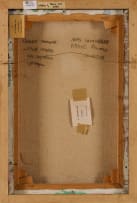
signed, dated 1998/00, inscribed with the artist's name, the title and medium on the reverse, inscribed with the artist's name, the title, the date and medium on two labels adhered to the reverse
Provenance
Estate Late Robert Hodgins.
Literature
Fraser, Sean (ed.) (2002) Robert Hodgins, Tafelberg: Cape Town. Illustrated in colour on page 14.
Notes
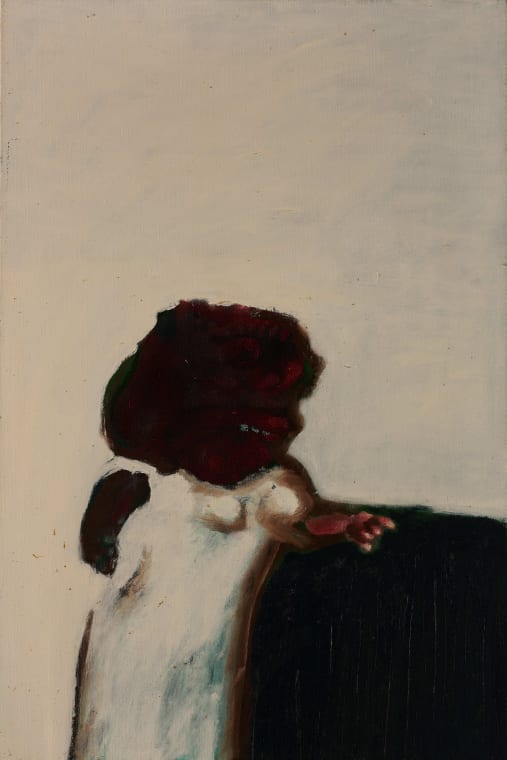
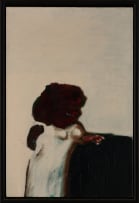
Tne example is a small, lethal painting called Little Mama. Almost two-thirds of the canvas consists of a variegated field of whitewash and scrabble, dribbling from delicate quail eggshell to dishwater grey, ivory, sometimes – towards the top right – the underside of a dove’s wing where, in a certain light, it might seem, but is not, a little green.
Breaking the pristine grubbiness of the white is the titular figure, whose immediate physical registration from the enormous head down is something like a giant slab of meat, the blood all but dried, forced unnaturally to fit, neckless, onto one of those female bodies that seems to have life mostly in derisive cartoons. This body forces us to imagine an invisible corset crimping in the excess weight of the lower body, only to push that excess upwards, where it emerges as breasts. The strangely detached orbs seem stuck on, collusive outsiders in a conspiracy of grotesque proportion.
Little Mama, who wears a white dress or nightgown, and who gestures with her left hand against the blocky leaden backdrop of an irregular black field, has no facial features of which to speak. There is, at most, the raw blob of a nose, the suggestion of an eye in the driedblood colossus of her head, and a faint glimmer of three overlarge teeth in an obscenely swollen mouth. Seemingly given authority by her left breast, her little left arm points impotently, pink index finger outstretched, of-scene: towards what? To designate whom, and for whose benefit? What witness could survive the encounter with this dark-skinned and pale-robed incubus? Does she lecture? Admonish? Or does she simply point? And what of her other, fatter dark arm, which disappears at the elbow, erased by the connecting passage of white field into dress? Is its remainder tucked behind the pocketed brownish curve at the left side of her dress (hand on hip, little madam), or is it bluntly lopped off, another physical correlative to imply the inner life of one who is an emotional and spiritual amputee? The coup of this canvas is, of course, the title. It is brutally affectionate — as if Hodgins, on applying the last vermilion dab to her nose, stood back and found himself profoundly amused by his own grotesque creation, a bossy and dangerous little personage of outsized head and undersized limbs, mute, pathetic, but threatening nonetheless. The emotional and visual clash is precisely contained in the title’s language: little mama. We are used to the concept of ‘mama’ as big. And while a big mama might be threatening, that’s to protect her young (the properly little ones); her capacity to threaten is integral to her nurturing. But here, this mama’s size is all in the absurd proportion of her dreadful head, which threatens at any moment to pitch her small body forward. We can hardly imagine the place from which she emerges or the bedroom to which she retires.
– Brenda Atkinson
More from Evening Sale